

English Version
Many Vietnamese companies are investing more heavily in corporate learning. Employees attend programs on leadership, management, sales, communication and professional skills.
Yet one critical question is often left unanswered:
“Have employees actually changed the way they work?”
This is the gap between Training and a genuine Learning Culture.
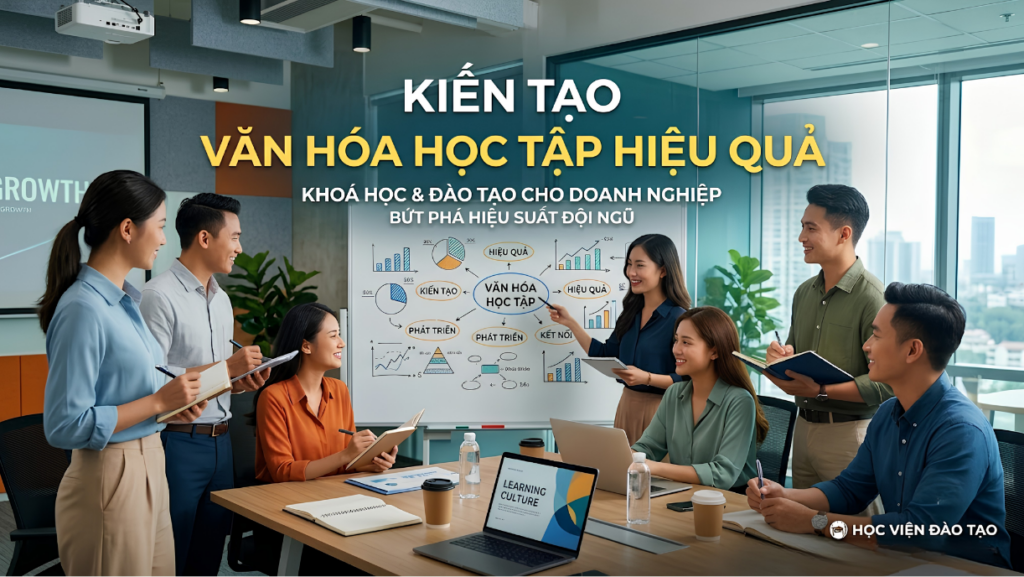
A training program may introduce a new model or skill. But an effective learning culture enables people to learn, apply, receive feedback, adjust, share and improve continuously through their work.
1. Learning must be a process, not an event
Google provides a powerful example. Through its Googler-to-Googler (g2g) program, around 80% of tracked training is delivered through an employee-to-employee learning network involving more than 6,000 Googlers. Google describes learning as a process requiring motivation, opportunities to practice and continuous feedback.
Google’s philosophy can be summarized in one powerful principle:
“Learning is a process, not an event.”
This changes the question organizations should ask.
Instead of asking:
“How many training programs should we deliver this year?”
Ask:
“What do we want employees to do differently after the learning experience?”
2. Leaders must become role models for learning
A learning culture cannot be built if leaders simply tell employees to learn.
Microsoft has made Growth Mindset an important part of its culture, emphasizing the shift from being “know-it-alls” to “learn-it-alls.” Microsoft describes a culture built around curiosity, continuous learning, experimentation and learning from mistakes.
The lesson is clear:
Employees learn more from what leaders practice than from what leaders preach.
When leaders ask questions, seek feedback, acknowledge what they do not know and openly share lessons from unsuccessful experiments, they make learning part of everyday organizational behavior.
3. Turn everyday work into a learning environment
Toyota offers another powerful example.
Its philosophy of Kaizen – continuous improvement is built around the idea that there is always a better way to perform the work. Toyota also emphasizes Genchi Genbutsu, going to the actual workplace and understanding problems through direct observation and experience.
This represents a fundamentally different approach to learning.
Learning does not happen only in the classroom. Learning happens through the work itself.
A meeting can become an opportunity to improve problem-solving. A new project can become a development experience. A mistake can become a team learning opportunity when people reflect, analyze and share what they have learned.
4. Managers must become Learning Coaches
This may be the most important link in the learning system.
After a training program, if managers never ask “What have you applied?”, never observe new behaviors and never provide feedback, knowledge may remain at the level of “something the employee attended.”
Microsoft’s own development approach illustrates the importance of this connection. Alongside formal learning, Microsoft emphasizes on-the-job stretch opportunities, career coaching and manager development in coaching and mentoring skills.
Therefore, organizations should not only train employees.
They must develop managers who know how to develop people.
5. Learning must create capability and career growth
Amazon provides another example at scale. In June 2025, Amazon reported that it had upskilled more than 700,000 employees globally through education and training programs. The company also emphasizes continuously reviewing its offerings based on employee feedback and changing skill requirements.
The most important lesson is not the number itself.
It is the connection between learning, career growth and the capabilities required for the future of work.
6. Do not measure learning culture by training hours
A traditional L&D system often focuses on:
- How many people attended?
- How many programs were delivered?
- How many training hours were completed?
- How satisfied were participants?
A mature Learning Culture asks different questions:
What did people apply?
What behaviors changed?
What capabilities improved?
What work outcomes became better?
What lessons were shared with others?
From “Training Culture” to “Learning Culture”
A Training Culture often starts with a training calendar.
A Learning Culture starts with questions:
What did we learn?
What did we apply?
What changed?
What will we do differently next time?
This is the transformation many organizations need.
A learning culture is not created by the number of courses a company delivers. It is created by how leaders model learning, how managers coach their people, how organizations turn experience into lessons, and how those lessons become action.
When this happens, training is no longer simply an HR expense.
Learning becomes an organizational capability — and a sustainable competitive advantage.
LET Perspective
At LET, we believe that a learning culture is not created by the number of training programs, but by how deeply learning becomes part of everyday work.
Training creates awareness.
Application builds capability.
Feedback drives progress.
And when the organization learns, improves and shares continuously, learning becomes a competitive capability.
So the most important question is not:
“What did employees learn?”
but:
“What are they doing differently because of what they learned?”
This is how LET sees Learning Culture: Learn → Apply → Improve → Impact.
Sources: